Friday, January 15, 2016

Made the most of Friday.

Last time we went by foot and ferry to Valletta we were intent on visiting the Co-Cathedral. Today we did. And if you're old you can get in for 25% less. Benefits, love them.

Awe. Sit. Look. Wonder.
I have to say that nothing, nothing prepared me for the shock that awaited. I've read about this place, I could bore you to death with the little I know about The Knights Hospitallers but all I can say is "go." Visit it. I've never seen anything like it, possibly because there probably isn't. Even my friend from Exmouth, not known for his appreciation of churches but an expert on all things motivated by steam told me that I had to go and that after I'd been I wouldn't believe what I'd seen. I know there's Florence, Venice and The Sistine Chapel and I haven't seen them but this must be up there.

Entry is through barriers, exit is, too but between the two sets of barriers I can't describe to you the majesty, the overwhelming and slightly uncomfortable feeling of personal perspectve being amended, realigned. There are quite a few seats which is just as well because sitting and contemplating the wonders surrounding you is an irresistable desire. At one point I looked across and the only other person I knew in that place was sat opposite contemplating, too.
On and on

The detail, the colour, the story on the ceilings, the sublime art of the Lengua chapels off the nave, the gravity of history enshrined by the tombstones from which the floor is made.Words? None worth writing even if I had the linguistic nous. A film by Simon Schama? Possibly. A visit? Definitely. I'll go again.

However, as someone who has stood in front of a few of Caravaggio's finest the most thrilling experience was to walk around the curtain of the Oratorio and find oneself face to face with his "Beheading of John The Baptist." At nearly 6m x 4m it's size was completely unexpected. And not a little overwhelming. I knew it was big but this!

Standing in front of it you were not looking at a painting as much as you were in the cell witnessing the event. I could wax lyrical but to do so is pointless, It was the highlight of my art education thus far.

Maltese Cross
It's not his muted hues, or his narrow colour palette, it's not the seamless depiction of people. It's the humanity he conveys in emotion, in the eyes of his subjects. It's always the eyes. The stance of the people he paints which as an ensemble tell the story in whole even though he only paints a part.

Here's the executioner lifting The Baptists head a little after the throat has been cut to let the life run out with his cleaver of a knife held behind his back, the young girl with the platter waiting to deliver her mistresses's request, the older lady stood leaning slightly forwards, head in hands showing the only sign of sorrow in the room, the gaoler pointing and exhorting the executioner to get on with it and the two other prisoners bent as they peer to witness the event from behind their own bars.

John, hands bound behind his back lying pale, blood flowing, waist covered by a red cloak. The flowing red draws the eye initially but acts as a centre point and a line which underlines the composition.

No element that isn't essential and even the space occupied by the blank wall of the lower right quarter drawing attention to the fact that this was done behind closed doors and only the essential characters necessary for the deed to be done are in the frame. The other two prisoners only there because the deed was suddenly requested and hastily carried out. No time to move them.

The perfection of his lighting.

And Caravaggio's signature in the blood. The only signature of his in existence.

Furthermore, standing in front of this monster master you are standing where Michelangelo Merisida de Caravaggio stood when he was removed from The Most High Order of The Knights Hospitallers of Malta for being Caravaggio. A very rare ocurrence in The Knights' history but somehow very Caravaggio.

How long did we look at this? No idea, a long, long time. Long enough for a security lady to take exception to a lady with a smartphone taking noisy photos of the painting directly in front of the "No Photos or Videos" signs. Why didn't she put her phone into silent mode and wait for the security lady to leave the room?

Moving on from here there are rooms of Vestments (stunning) and tapestries, but we were in Bayeux a couple of months ago.

Once outside in the courtyard we sat and contemplated some more. Then we found a Pastizzi or two and caught the ferry home. Once home we felt that we should sample some more Caravaggio goodness and that we ought to support our local Italian next door.

Magnificent day. Privileged. 
Extreme left, our door. Italian Gelateria for a Friday treat. Been a long week!

Voldemort revisited

Lest you should think that life is entirely a bed of roses I must shatter that illusion with today's post,
Today we walked the local environs, or as much as we were permitted,

Looking directly ahead from our balcony there is sea, as far as the eye can see. Right up to the horizon, in fact. Usually there are boats, today an 86,300 ton LPG carrier from Hammerfest and a 66,000 ton container ship from China whilst I was watching although I will not dwell on them as I believe there was the delicate scent of sarcasm in a message from one of my wife's friends regarding her sharing my interest in boats a couple of days ago. As if I would inflict my interest in boats and harbours on anyone, let alone my nearest and dearest unless she was as interested as me. Isn't she? Have I missed something here?

Anyway, our balcony and the walk. Ahead lies sea and ships. To the right there are monotonous tower blocks like ours and three tower cranes. To the left there are fifteen tower cranes, tower blocks vying to outdo each other, a "Cavalier "Art" Hotel", a Hilton and a tower. A most hideous tower. Hideous in that it is so out of kilter with it's environment, where everything is a rich, warm limestone of  creamy hues, even the sheet steel cladding of the "Dolce Vita" is painted a creamy limestone hue but this tower is a dirty sort of French blue with terracotta vertices. As the sun catches it I'm reminded of round wire nails being hammered into the ground.

This tower can be seen from everywhere we have been on the island and we have been to lots of places. I guess that it's existence and permission to be built lies in the hugely beneficial goodness that each of its floors bring to mankind.

We decided to wander that way as we have looked at it for nigh on a fortnight now. At the front door cross the road and go left. The wander to Balluta bay is pleasant enough, thence on to Spinola bay, hardly an energetic tramp but far more interesting. I could explain about the boats and a conversation I had with a man about them which was exceedingly fascinating but I won't lest I give further ammunition to her whatsapp friend.

Along the seafront. almost at sea level is a delight. Fortunately, there are many seats one of which was occupied whilst I was engaged in conversation with a local boat owner and once past them a sea side path which passes in front of a row of old houses with an old boat or two parked outside, which I won't dwell on and a house with three balconies over which  the most intense bougainvillea cascades. Then the path turns right along the water's edge but here you cannot go as there's a wall of concrete laid across it right form the "Art" hotel to the water's edge. You could get round it but you'd need to be more athletic than I.

Around the front of the hotel and access to the water's edge path is gained by a dozen steps. Again, athleticism is required as a padlocked gate allows looking but no access.  Retrace your steps round"The Cat Hotel" (I jest not .... I couldn't look let alone take a photo that would do it justice) and you arrive at a sign telling you that this gate is open from 0800-2000. There's another sign informing you that this is Portomso Marina.

Through the arch in which the tower is perfectly framed and down three flight of concrete stairs  brings you to the most soulless, plastic flower adorned excuse for a marina that I've ever wandered through. A "Sunseeker-Malta" sign is about the only sign of life and even that seems comatose. Pristine boats, all 40 - 60 feet with flags from everywhere, notably Russia, with names like "Cash" moored next to "Prosperity" are so tightly fendered together that I could detect no movement whatsoever.

Once through the concrete canyon there is an open area leading to the north pier. Now if there's a quay it has to be gone down. Right down. Which is just as well as all other exits are gated, locked and I suspect armed. So down the end I go, round the  back and along the sea wall on the seaward side at the end of which there's the path again. Hooray, the one that began way back at bougainvillea cottage. Once on the path it goes nowhere. They've got a swing shovel and removed about a distance of about 50metres and filled the gap with jagged boulders. You can't get round it because there's a load of chain link fencing to stop you.

Once back in the concrete canyon we find a lift by the Sunseeker shop to avoid the steps, Once up we carry on to the next bit of sea side. Here there's the other end of the path but it just meets the road we're on. Staying on it we enter St.George's Bay. This I have been looking forward to for ages. Google Malta web cams and Skyline cameras have view of this beach in which it looks very pretty.

Reality bites. The sand isn't sand and it bites, too. It's Jordanian gravel. Evil on the feet to 'meor bred beach people. They dump a coaster load here every year. I'll say no more as that's about boats. It's hideous. Utterly awful, everything I dislike. And standing on the beach looking landward are twelve of the tower cranes we can see from our balcony. At the southern end of the beach the shadow of an ever rising block already encroaches over at least a tenth of the gravel and it's nowhere near the height of the tower cranes working round it.
Gravel beach ever higher rise and the beach kiosk is called "Pearly Bay"

A hasty retreat to Balluta bay was undertaken at a pace. A sunny seat and refreshment was gratefully taken with a feeling of relief.

As for the beneficient hideous tower, we went in. It's a casino and it has an observation deck with fabulous views, or so the lady at the desk said. We could go up but only after 10 at night and it would cost us the entry fee for the nightclub that occupies it. Worse, the blue and terracotta? Plasticised cladding. Not for the benefit of the mass of humanity, then, but for a small wealthy set and a group of local politicians, no doubt better off now than they once were. Possibly.

So there, not much about boats which should make one of my wife's friends smugly satisfied and the forecast for Saturday and Sunday is heavy rain and low teens. Tomorrow to make the most of and then hatches and battens. That's not a nautical reference, either!

Wednesday, January 13, 2016

Bus free!

For a week we've had a go anywhere anytime card that lasted well, a week. Thus we have endeavoured to get our money's worth and a bit. I'd have to ask management if we succeeded but I think we have. I certainly feel as though I've been bounced about, bruised and battered on our bus travels.

Today, to celebrate the expiry of our Tallinja Explore card the decision was taken to see Valletta Co-Cathedral by foot and ferry. With a leader suitably smartgpsmapped she was able to follow her outstretched arm and I merely followed her. A ten - twenty minute bus ride around the coast road gave way to a sub ten minute wander through a maze of back streets to the ferry. New tiny supermarkets, general stores, pastizzi holes in the wall and a gadget shop were found and examined as well as a "coffee" shop boasting a huge range of coffees. It readily became apparent that despite encouraging notices and shop displays what they actually meant was we have one type of ground coffee which we'll turn into a range of drinks. Four, to be precise, unless you include with/without milk/sugar. Disappointment but only a coffee anorak would feel it.

A €1.50 each ferry ride takes us to Valletta. As our fellow travellers disembark they follow the signs and we observe the bottleneck in time to take an alternative course. Our course avoids the minibuses offering rides up the hill for €1 and takes us past an innocuous looking building called "Fortifications Interpretations Centre" above which a banner cable tied to a railing announced "Free." I was all for walking past as free often means not worth paying for. Management, now with smartgpsmap firmly buried in the depths of the handbag questioned my onward intent, reminding me that a similar place in the walls of St.Malo was a gem.

Mind your head between displays.
With initial reluctance I again reverted to a following role.

A couple of hours later we found the exit.

It's actually built into the walls and explains how and why these fortifications were built over the centuries. There was one other couple wandering about when we were. After having got to the "end" you are enticed on to an outside walkway on top of this particular wall. It has a lift to ease the upward journey and the best toilets thus far encountered.

The views are magnificent but sat in a corner was a member of staff on a fag break. He asked us what we thought and I had to ask a few questions. His answers were eloquent and erudite, his enthusiasm unquenchable, his pride in his island rightly huge, it was quite an experience listening to him. More questions followed. I think he was pleased that we were aware of some of the history and not complete numpties. The arrival of the other couple elicited some further questions of him and eventually he had to return to work.

Once outside immediately to the left of the building and again, in the walls, we found a lift to Melitta street. A lift that looked unused. Free. The ascent took us to the main street, or one end of it. The fortifications at the top of this lift have the remnants of anti-aircraft gun emplacements every few feet except when they were HAA, heavy anti-aircraft gun emplacements in which case they're every few yards. It should be obvious but wherever there are AA or HAA emplacements the views are magnificent.

This wall leads into "Hastings Gardens" and thence to the new parliament buildings.

Fortified walls above the "Fortifications Interpretations Centre" looking towards Manoel Fort, Sliema and the Voldemort Tower, St.Julian, which we can see from our balcony.
By now the need for Pastizzis, refreshment of the liquid type and a seat with a view was required. We are familiar enough with Valletta to know the shortest route to see those needs met. On the way we passed a bookshop. I bought a history of Malta recommended by the bookshop man.

We still haven't seen the Co-Cathedral. Nor Fort St.Elmo, the war Museum or any of the places on the Valletta list let alone all the others. But we have had yet another enthralling day.

Three weeks tonight we'll be home. How on earth can we fit it all in?


PS. If these get a bit intermittent it may have something to do with the laptop which keeps suddenly going blank. The power supply plug has melted again but this time I have no soldering iron and heat shrink to mend it so currently the wires are kept apart with hope. Tomorrow I'll see if I can find a bit of plastic ......

Fiat 500's 0 Buses 2

A long bus trip to Mellieha Bay yesterday was remarkable if only for it's unremarkableness.

Bus trip elongated by another bus accident in which a bus turning a corner in St.Julian's happened to intersect with an inelegantly parked Fiat 500, the second one we've seen embedded in the side of a bus. The ensuing traffic jams as a result of their dangerous liaisons are truly humongous but we're in no hurry which is not so for many of our fellow travellers. I try to feel sorry for the watch consulters and phone users generating so much anxiety whilst sat in a stationary bus. I'm not too good at empathy with those in a hurry any more. Sorry.

We didn't sit in these seats.
We sat in sunny ones


This is our second such lengthened trip in a bus which considering we've only undertaken two is pretty good. The other was in Hamrun on the way to Mdina. In both cases Fiat 500's not so much badly parked as abandoned near a pavement end up embedded in the side of a bus. Both were finally halted by the rear wheels of the bus and both resulted in severely disfigured Fiat 500's. I'm glad that apart from a bus I've only been driven in a very large blacked out 4x4, probably one of the finest and most desirable 4x4's in the world. Ever.

Mellieha Bay. OK. Found a bar on the beach which reached out into the water. Found a seat in the sun. Had a drink or two. Discussed who would carry the fleeces. Paddled along a beach. Wished the cossie was to hand. Envied the few bathers. One boat came into the jetty, moored up, nothing else of note. Didn't have any gear aboard so I don't know what she was up to.

Wandered around some non descript back streets. Met a hill going upwards. Turned around. Saw the bus we wanted pass by. Wandered about a bit more. Met a nice man, had a nice conversation. Couldn't find a Pastizzi shop. Caught next bus home. Uneventful trip.

Got home, had a beer on the balcony. Got Pizza, far too big so it'll do tonight, too. Glass of red.

That's it. The unremarkable Mellieha Bay. Hot. Sandy beach. Blue sea warm enough for a pleasant dip. Beach sheds full of rows and rows of stacks of beach loungers, jet ski's being pressure washed by the dozen, no by the score. Closed dive school operators with deflated rib's stacked high. Locked up shops with posters in the windows and painted boards hanging on the walls offering rib hire, speedboat hire, ski tuition and evening parties.
Taken from our seats in "Munchies," Mellieha Bay beach
 I'd hate it in summer!

Monday, January 11, 2016

Just Another Manic Monday

Silly o'clock and a road drill starts up underneath our bedroom window.
Coffee
Press button on radio and BBC World Service tell me that David Bowie has died.
Coffee
Phone call, "would I like to go for a trip on a boat?"
Change from shorts to jeans.


Bit of a morning, really.

However, I can report that the road drill lorry has gone.
David Bowie's death is a reason to listen to his albums that I have on the iPod.
The only way to get Valletta in perspective is to see it as you approach the harbour from seaward.

There is nothing, absolutely nothing, which is as much fun as messing about in boats when it's warm, calm, sunny and the ones you are with know you well enough to put up with you!

Sunday, January 10, 2016

Church . . . . History . . . .

A scorcher of a Sunday, just what we needed after my failure to turn off the Jacuzzi in the bath last night. Like most things it's obvious when you know how but when you don't it's a bit damp. It's there and had to be tried. After all, I reasoned, no matter how much water could be spilled it wouldn't amount to a washing machine full, would it?

I confess that this morning there were a few puddles to avoid but by the time we got in this evening the weather had seen off all the evidence.

The photo (left) was taken on the way to church and is looking eastwards down Sliema harbour with Manoel Island on the right. Nice day for January, eh? I had considered wearing shorts but going to a church you've never been to it was suggested that jeans would be more acceptable. Arriving, it appeared that a suit, starched white shirt and tie could be a condition of entry but once in it became apparent that not everyone was rigged in Sunday best. Most were.

Smart church, modern projector and songs but in all other respects very 1960's. King James would have felt at home and he'd probably have understood most of the terminology. However, the pastor made one think and a hasty retreat was beaten afterwards but we'll probably go again.  As it was the jeans meant that the onward journey had to be preceded by a trip home for the shorts.

Once suitably attired two comfortable, by that I mean we sat, bus journeys saw us at Birgu where I pointed out "Connda Vennessa" which, but for another example of my utter folly, could have been ours for the month. Grrrrrrrrr.

Past her the vessels just get bigger and finally biggest as in the photo, right, just google "Maltese Falcon" but not the one with Humphrey Bogart, good though that is. A 23mm lens on a 1.6 crop x-trans sensor gives 40mm. Far too long a lens to get all the boat in so just admire her masts and wallow in the fact that what you see in the photo cost $80,000,000, just the masts, yards, sails and computers to set them. The boat was another $100,000,000 or more. Yours for $500,000 a week plus expenses.

She lies under Fort St.Angelo, a massively built edifice that represents the furthest westward point of the expansionist Ottoman Empire under Suleiman in 1565. It inspires awe. It elicits gratitude. It makes you wonder just how different history would have been had it fallen in September of 1565. That it didn't is, some say, down to Divine intervention and who am I to argue with that.

As you follow the walls around a well worn and precarious walkway takes you from Grand Harbour to the tip of Birgu, the southern side of Valletta harbour from where the view is magnificent. See below.

 This afternoon, sat on a rock just looking at a harbour entrance into which the Phoenicians sailed 3000 years ago, the Romans a thousand years later, the Turks 500 years after them, Napoleon came for two years till the British came and kicked him out (at the request of the Maltese I hasten to add). The Italians wanted to come in but gave up trying, the Germans were desperate to make their entrance but were denied by Maltese and British defiance and many attribute the success of that stand (1940-1943) to Divine intervention as well.

Looking NNW from the base of Fort.St.Angelo.

On the right, Fort St.Angelo wall, beyond that Fort Ricazzoli where Dragut set up his batteries in 1565, the harbour arms are relatively recent but on the left, beyond the memorial bell tower is Fort St.Elmo into which the heads of captured Turks were fired from here after St.Elmo fell and the last of the Knights defending it were beheaded, set on crucifixes and floated over to De La Vallette in Fort St.Angelo

It was because of this harbour that Malta has been fought over so may times and it is why from the winter of 1941 to late in 1943 it became the most bombed piece of land in all the world. In the six weeks from mid April 1942 more bombs were dropped here than were dropped on all of UK during the war. For 186 days the all clear didn't sound.

History, those who fail to learn from it are condemned to repeat it, or so Edmund Burke is meant to have said but Gandhi said, "A small body of determined spirits fired by an unquenchable faith in their mission can alter the course of history"which is a shame because it sounds so Churchillianly appropriate with regard to Malta!


Saturday, January 09, 2016

Start the day with a paddle.

Saturday dawned beautifully, I suppose. The sun was quite high when I first saw it. The sky was blue the sea was that stunning Mediterranean turquoise, the wind light to non existent. The water was a flat as a dab and spreading uniformly across the kitchen floor.

The first job of the day was to put the washing machine on. That wasn't my job and I didn't do it. No, my job was to make the first coffee of the day. And the second. However, having filled and turned on the kettle I made my way to the balcony for a gawp at the stunningly blue vista spread before me. The click of the kettle caused me to turn and wander towards it. Coffee makings prepared, organised and ready all that was left was to traverse the steadily spreading pond between the kettle an me.

Had I been wearing slippers I may not have noticed but I wasn't and I did. Just as well. Fortunately the kettle had boiled as the electric went awol and the water continued to flow. At least, I noted, the floors are perfectly level.

At times like this cold calculations are needed and definitive actions need undertaking so I hollered and made the coffee. Bath towels formed a coffer dam around the washing machine and the spreading suds were contained. I dragged the machine out of it's bay into it's sea and established that the fault lay inside.

We have a caretaker called "Felix" who I called and appraised of the situation.
15 minutes later he was there with a lady who had mops and energy. He restored the electricity and she restored the floors.

It may take longer to restore the washing machine, I think.

So, two coffees later we caught the bus to Sliema ferry and wandered to Tigne Point, a shopping complex of hideous design occupying the site formerly known as Dragut Point, this being where Dragut the Corsair in the pay of Suliman landed in May 1565. Had he landed in April the moslem hordes may well have overrun Malta. He didn't and the moslem in charge of Suliman's fleet, Piale, had fallen out with the moslem in charge of his land forces, Mustafa, which was not ideal in the circumstances. Dragut got them on the same side but the die had been cast, the planned plan not as effectively executed as it ought to have been with the result that Jean Parisot de la Vallette, Grand Master of the Knights Hospitallers was better able to plan, prepare and execute his defensive strategy, ably assisted by his main man Sir Oliver Starkey, the only non Grand Master to be buried in the Cathedral.

So, we stood in the winter of 2015 where Dragut stood in the summer of 1565 but instead of looking across at Mount Sciberras and Mustafa's numerous canons we looked at Valletta, begun by and named after the victorious commander. A worthy place for one so courageous and determined.
Valletta from Dragut Point, Saturday 9th January 2016. Between coffee's #2 and #3.

Friday, January 08, 2016

.... and breathe.

Where's the week gone, eh?

Monday get bearings and bus card. Watch a few boats over Tas-Sliema strand by Manoel Island.

Tuesday, Valetta. Very hot, serious archtecture, modern exquisitely blended with old. A magnificent parliament building and bridge by Mr.Piano, he of Shard fame, or not. Walls. Forts. Boats observed from on high. Wonderful..

Wednesday, Marsaxlokk. Bused adventure. Pretty calm, bit bouncy but seated, mostly. Boats close up. Huge ones observed from afar as they did their business at the freeport, a modern container port. Huge derricks and all that stuff. A harbour full of fishing boats from proper trawlers to  tiny toshers. Long liners, netters and trammel netters, too. Oh, sublime.


Thursday a breakfast time phone call from a friend. No bus nonsense today, Chauffeured about in a very large 4x4, airconned luxury and leather. Magic carpet stuff. Went to Marsa. Saw some boats. These, in fact,as well as lots of others. Sheltered on the afterdeck watching a passing shower. Look closely and in the far centre distance you'll see a plastic wrapped vessel in dock. This is 'A' which we last saw in Formentera last June. She's well worth a google.

Once the shower had passed we drove off past a warehouse full of all the old buses and a liner that looked like it was a super yacht once, which indeed it is, or was. Mr.Gadaffi's in fact but seeing as no one's paying the bills it's just left accruing debt. Further along and we stopped at another yard where another good friend who I've known for nearly 40 years is fitting out a new workshop. I'm used to seeing him in tiny sheds with gear everywhere and only room to swing a small kitten and even then it would get a severe headache unless swung with extreme care but here he was in a workshop bigger than a tennis court with all manner of marine engine refurbising goodness. Across the road were a few of their shove ashore skiffs. Bit different form our skiffs with a pair of paddles and a Seagul Silver Century when we were big enough to start one. 1200hp a boat. 50kts with 12 aboard and their gear. Range 250 miles. Fuel tanks, big. Four of these and four more with a wheelhouse for a bit more shelter in poor weather.

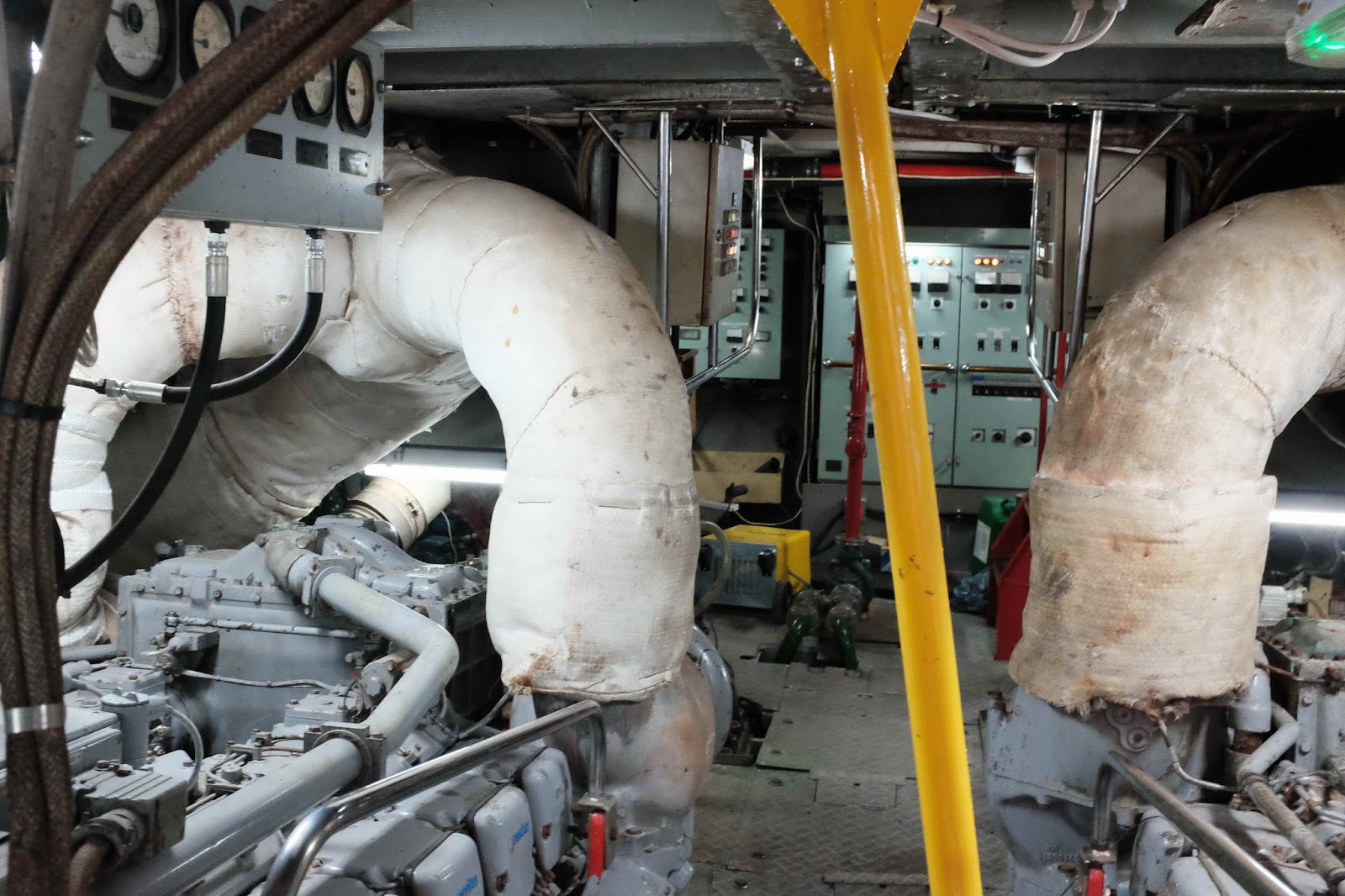
Then over the road to see a pair of 2,500hp V16 MTU's. Even better, fired them up. Oooooooooooh.
What was it Robert Duval said in Apocalypse Now? "I love the smell of big marine diesels first thing in the morning" or something like that.
Lovely.

A short drive later and Birgu for a pause to see the boat that we could have rented for this month. Currently up for sale and I have to say that I think I was a bit slack in not biting off the hand that offered her. Yours today for a not insignificant sum well into six figures. My driver, for he it was who offered it to us seemed to take great delight in showing me this marvel of naval architecture. Fitted out to the very highest standards, more mod cons than I can even imagine and I didn't take him up on it. It's not often I stand on a quayside feeling utterly, totally stupid.

Seeing my distress I was offered a drink whilst gawping and wallowing in an ocean of self recrimination the depths of which were uncharted in my experience. And it was offered significantly cheaper than the flat I'm typing in now. What a fool I am.

The beer was nice and medicinally effective. So effective in fact that we went further into Birgu and saw "Maltese Falcon" under the walls of Fort St.Angelo. Both are massive. One is new, the other is old. Both have to be seen to be appreciated.

Still feeling sorry for myself we went and sat looking at a few boats for further refreshment, after which a trip to Marsaskala to sit watching boats on the wharf outside his local. Suitably primed, I'm sure, golden fizzy stuff gave way to proper black stuff and it was proper, too.

Finally, a ride back to my very door in the dark. A day that will stand alone as the best one so far ..... not that I admitted that to my wife who had doubtlessly busied herself in my absence.

Today we rode buses, standing, shaking and rattling from here to Mdina and back. Mdina is not on the coast. Walled city. Quiet. Narrow streets. Nice views. No boats.

I could get to like Malta and if anyone called Karl offers you a boat to reside on bite his hand off and if that same Karl suggests having a pint be aware that there will never be "a" pint, ever!
Cheers, Karl.

Now it's the weekend and I'm knackered.
Time to take it easy for a few\days.
Maybe.


And I still feel more than a bit stupid, as indeed I should.


Tuesday, January 05, 2016

Steep into History

Should you arrive in Valletta. Malta G.C. at sea level you will exert some strenuous effort if you are to walk the main street. Steep hills reminding me of Windsor Hill with a bit of 'Meor in the middle and the end lead you up the sides of Mt.Scibberas where you are rewarded by a multitude of delights.

Highly recommended would be a wander about Barrakka Gardens, Higher and Lower which overlook Grand Harbour. Magnificent.

However, if you arrive by bus you are dropped at the very gate to the city so elevation changes are (mostly) circumvented. This was just as well because rising at the crack of late morning after coffee#1 and struggling to do justice to coffee#2 one left with what one had dropped on the floor. Thus jeans and not shorts, shoes not sandals were the rig of the day. Wholly inappropriate.

The Wow!'s tumbled one on top of the other, just sitting contemplating and looking, not to mention perspiring was enough.

Sat here now, glass of Caravaggio Red, showered, shorted and not quite as sweltered one remains a bit overwhelmed.

Upper Barrakka Gardens, opposite the building recently made famous on News24 as HM QE2 welcomed the CHOGM to her meeting. Over to her left tucked in a shady corner amid a myriad of plaques overseen by a bust of W.S.Churchill is one pillar, passed by by most which bears the inscription:


"Few could vie with him in usefulness of talent

And fewer still possessed a heart more benevolent

Or disposition more social

He died in the prime of life

But lived long enough to know

How fully he had secured the respect

And esteem of all good men."


You need to move to the other side to find that this being:

"To the memory of
Clement Martin Edwards
Lieut Col of His Majestys First Ceylon Reg
Who died at Valletta
After a protracted and severe illness
On the 17 March 1816
Aged 36 years"


Looking around at the host of memorials mostly paid for by people who knew them it's hard not to be moved when you think about what's happened here during The Great Siege of  1565, the Siege of 1940 - 1943, The Napoleonic Wars and numerous others confrontations over 3000 years or so.

Clement Martin Edwards, never heard of him but what a man to have earned such an epithet at 36. Like so many others who suffered here that no one knows of but did great things at great expense.

Makes me a bit ashamed at having moaned a little about not being in shorts and sandals on a hot day.

Monday, January 04, 2016

Foreign .... and yet .....

Flying CheapoAir one is forced to wait in departure lines watching the rain glistening in the pre pre dawn darkness. Then the doors are opened and a man in hi viz passes us on to the next hi viz at the crossing thence another at the front stairs who waves us to the rear.

 Brought to a halt as we ascend, the rain makes the coat heavier on the winward side but leaning into the wind only makes the collar gather the water and funnel it inside. The doorway beckons and the light illuminates a stewardess smiling radiantly like one of those kids coerced into child pageants that Americans seem to consider appropriate. Actually, she may have felt sorry for us, I did.

Sat, stowed and slept. Woke to the sun shining over The Alps, then it shone over Monaco, Corsica, Sicily and finally, here.

Disembarkation was smooth and swift hardly allowing time to divest another layer and stow it in the backpack before we were out through the arrivals doors. But what a crowded airport, or so I thought. In retrospect it's only a small airport and we're used to acres of emptiness in Spanish tourismo aeropuertos. This isn't Spain.

At the arrivals gate the first person in line of sight was my friend, Karl, who I've known since he was a teenager, with his wife and child awaiting the arrival of his son who'd been on our flight. My eyes must have popped as it was so totally unexpected. I guess that means we'll have to meet up and have beer, or two. However, he had a son to catch and we had a bus. A X2 bus.

It's east to spot a bus here as they all have BUS as the first three characters on their number plates. X signifies express and indeed we set of with gusto that a certain Spanish bus driver last year from Alicante to the aeropuerto would have been proud of.

Inital rapidity gave way to a lengthy stop in what seemed to be in a Lidl's car park whilst drivers were changed. Leisurely would be a gracious way to describe the handover. A further wallow and lean for a few kms saw us parked in alongside a nondescript block wall plastered in pasted posters. Then nothing happened. We all sat, a few went out for a fag or two. Silence reigned. We stayed. And stayed. Apparently there used to be a X2 bus every half hour but since 20th December there's only been an hourly service so it waits for half an hour mid route to save reprinting timetables for all stops.

Once the diesel had whimpered into life we were only a few stops from our destination. Google Earth had show us where to get off but it could give no clues as to when. I'm not entirely sure that the bus co. know either.

A bit of a palaver to get sorted but that was finger trouble and inconsequential, the only effect was to raise my thirst threshold from merely thirsty to raging. Fortunately, out side our very door, over the road is a bar with a "Cisk" (pronounced Chisk) sign. Pint, I said. Sit, he said. I did. It was a pint if you include the 3/4" (19mm) of froth. I drank. San Miguel it is not. Not by a very, very long way. Cheapish, though. You are unlikely to see a Cisk tap in any UK pub anytime soon and if you do I wouldn't bother.

I also noted the strangeness of being foreign when everything's so English. The adverts, notices, language mostly, shop signs, familiar road signage, postboxes and telephone kiosks. It all feels so familiar. Comfortable in a strange way. Not really foreign enough. I caught myself looking over my left shoulder before crossing the road. It's odd being warm in winter where cars drive on the left. And 13A square pin sockets, too.

The strangest thing, though, was seeing a "Pastizzi" sign next to the bar. Pastizzis come in mushy pea pastizzi, mushroom pastizzi, cheese pastizzi, chicken pastizzi or Cornish.

Mind you, a dozen of them wouldn't do justice to a fitty pasty. They are foreigners after all.

Keywords: Grumpy;Santa;Beer

Years ago my colleague, a very Scottish Bob, recommended that I use keywords to catalogue my photos. Last week I was trying to find a specific photo and failed abysmally so I though that the act of keywording would make a decent new year's resolution.

The first three are attached to the photo (left) of a present from one who thinks she knows me well. Rather cruel, I thought and were I American I'd doubtless be making urgent appointments to see an analyst. Or a lawyer for hurting my feelings. Surely not being upset must be a human right, isn't it? Fortunately, I'm not and aren't. I am, however, vastly misunderstood.

The percieved state of grumpiness in which some believe me to reside is meterological not psychological.

Having spent days, nay weeks if not months observing raindrops coming to an abrupt halt on window panes before colliding into each other producing rivulets on the glass and making streams on the patio before forming puddles in the garden I have concluded that a prolonged period of consecutive rain days is not soul enhancing.

Furthermore, looking out to sea and being unable to see where the sea ends and the sky begins doesn't lift the spirit much either, nor does uniform greyness observed from all elevations and directions help spread much joy. As for considering how many layers to don each day and wondering if the coat has dried out from yesterday's dousing, that can get really tiresome, too. It could easily cause the exhibition of that emotion sometimes percieved as grumpiness in one more emotionally fragile than me, obviously.

It should be readily apparent that what one needs is a balcony. A horizon. Air that wafts warmly about sans dampness. A bit of sun and less all enveloping cloud more distant pale white fluffines is what we want. As is to wake up knowing that shirt sleeves will do and that the most exacting decision to be made each day is shorts or jeans.

This years balcony looks out at a clear horizon with no precipitation in sight. Shirt sleeves are more than sufficient and shorts quite likely once unpacked.

Grumpiness? Don't know what it is. The whole world looks glorious, the future is a joy to contemplate. Even the prospect of supermarket shopping is an event eagerly anticipated.

See, not a trace of grumpiness. Sheer joy. Delight.
It's meteorological as I've always known and so should all who know me.

I'm even coming around to the view that being born in Wales is no bad thing.

Not ideal, of course but not as bad as it could be.

Probably!

Sunday, October 04, 2015

Daniel.

I never knew Daniel.

If anyone had an idyllic growing up it was me. Many Friday nights I would sleep down at Nana and Da's because they lived down the harbour so it was less far to go on Saturday morning but Saturday evenings was bathtime, and bed unless I slept in Nana and Granda's at "Elhanan" 9a Bowling Green Terrace, in which case I was bathed at home, dressed in Sunday Best and with pyjamas wrapped in a dressing gown I walked down the road to their house.

Usually it was being allowed to beat Nana at checkers or dummies before being told that it was bedtime and asked, "what did I want for supper?"that I liked. I think it was the suppers that I most looked forward to.

One night a year was always different. She tended to look sideways at the TV in the corner as she glanced at it over her knitting rather than looked at it properly. But each November for "The Royal British Legion's Service of Remembrance live from The Royal Albert Hall" as the ever so formal BBC announcer began to intone she was right there in front of it.

I'd be sat next to her in a big brown high back chair with wooden flat arms that cut into you so I needed the shiny dark red cushions. I liked the Royal Navy Gun Carriage Teams racing about throwing tons of equipment around with such precision and control but the marching bands and stertorous voices were a bit of a bore, really. It didn't matter as I'd fall asleep and wake up in uncle John's bed even though he'd left home years before it was always his bed.

Later on, I guess by the time I was 6 or 7 the suppers had taken their toll so I'd wake up where I went to sleep but with the matching brown chair placed under my feet so making a bed between two chairs.

Only once that I can remember did I ask her what it was all about but I've never forgotten her reply. "This is for Daniel," she said nodding at the telly.

All I knew of Daniel was that he was killed in the war and little else. Nana said that he was "a breaa handsome boy" which was a bit odd because everyone who ever lived was " a breaa handsome cheeld" but I don't remember her mentioning "boy", a "maid" occasionally. Like "Maid Dorcas" who was Daniel's sister and lived up the road. Dorcas has always been in St.Ives. Jane, his other sister, lived in London and we visited once or twice but eventually she and Ted came back and now live down Gulval, I think. The last time I saw them was at uncle John and aunt Joan's 50th anniversary.

Nana's sister, Dorcas was Daniel's mum and lived down Carnglaze Place and from her front window you could see right down the quay.  Later she moved in with Maid Dorcas and her husband, Jimmy.

Mum said Daniel was quiet and really gentle, a lovely chap, others have said he was a fine mason so he had a trade. I also heard that he was killed by mortar fire in Caen.

Between Nana's fireplace and the telly in the corner was a large wood glass fronted bookcase cabinet. It  was huge, it was taller than me but that meant that it was really only about 4' tall and about the same wide. It had sliding glass doors and four shelves, three full of Granda's books and the top shelf full of trinkets, Granda's cufflinks, arm bands and hearing aids. And photos. One was of a smart uniformed young man, about a two-and-a-quarter square photo sandwiched between two bits of glass and held in a wooden base. That was Daniel. The other photo was of uncle John stood next to a headstone, I think with his left hand on it. That was Daniel, too.

I never knew what happened to Daniel, either.

Today I went to where uncle John stood and we've unravelled a bit more about Daniel. When I say "we" I really mean my research assistant who sits behind me waiting for me to stop tapping away but beside me is a sheaf of papers, official documents, photocopies and all sorts. Her methodical and intense way of going about finding stuff is amazing but, hey, I've done googling. And we went to the Turisme Information Centre yesterday, here in Caen. Maps. They have maps and I love maps.

So, this is what we have found out.

Daniel was part of 3 Brigade who landed on Sword beach. He was in 2nd. Batt. Kings Shropshire Light Infantry and would have landed at Queen Beach at 1000 . This beach is the western most end of Sword Beach. The Eastern extremity of Sword was the Port of Ouistreham, the western end was at or before the start of St.Aubin-sur-Mer.

They met fierce resistance as they fought to move inland but eventually Douvres, Hermanville and Colleville were taken but the rate of advance was slow. Most of the information comes from the armoured division personnel, they had 3 squadrons of Sherman Tanks and were the spearhead but progress was slow as they were up against SS troops and Hitler Youth Brigades.

Montgomery wanted Caen taken and decided to launch Operation Charnwood. This would last from 7th - 9th July. Over the night of 7th-8th heavy bombers struck in force at the northern edge of Caen, a strip about 2 1/2 miles long and a mile or so wide. So great was the destruction that it hampered the eventual march into the town . Today, on the tourist office map it notes the "unbecoming architecture" that now is found there.

 The armoured division and KSLI were tasked with taking "Libesey Wood"which was the last defended high ground between them and Caen. After the bombing at 0420 the ground assault began with a bombardment of the units 25lb guns and the tanks.

Tanks can not batter a way through established woodland so their strategy was to bombard the position with artillery and then the tanks would encircle it. If the bombardment didn't kill all the defenders or scare then off it was utterly imperative that once ground troops went in there was no possibility of further troops moving up from Caen to reinforce the position.

At 1000 the tank commander signalled that it was encircled and the KSLI went in to mop up the wood. This they did, emerging on the southern side of the wood at 1500. Now they were to advance on "Ring Contour 60". They were fighting the recently arrived infantry of the 21st Panzer Division.

At some time after that an 88mm field gun, deadly accurate and efficient opened up. The Shermans couldn't engage with the 88mm from their current position so they had to withdraw, which they did, but not before losing five tanks and their crews. It was at this point that the most senior KSLI officer was badly wounded. He was found beside a wrecked tank and was taken to the Forward Casualty Post at Bieville-Beuville. He is quoted as saying that he was unaware of how tired he was having been active for at least 48hours.

The enemy kept the infantry pinned down using observers from the chimneys on the outskirts of Caen. The infantry dug in"with the utmost rapidity."A tank gunner, Sid Moore in a Sherman of 144th Regt.Royal Armoured Corps and the rest of his squadron were advanced from 2 miles north of Libesey wood to give cover to the dug in infantry. Which they did. One tank commander said that the infantry had no where to go and just had to take it.

A member of The Royal Ulster Rifles reported that as night fell we heard the first mortars open up.
A short time later the enemy was "liquidated" and the mortars fell silent.

On one website there is a footnote to the effect that one Hugh Patrick Maguire single handedly took out the 88mm killing two of it's four man crew and capturing the others but no time for this action is given.

There are conflicting numbers of casualties given, one document says 80, one 107 and one 118. Daniel was dead when he arrived at the Casualty Post at Bieville-Beuville. Where he was buried. I know this because Dad knewThomas Berriman another St.Ives man, who was there as a medic, who told Dad that he was praying that Daniel would be brought in wounded. But he wasn't.

Daniel was later reburied in the cemetery at Douvres-la-Deliverande. 

Daniel died at the end of a hot and sunny Saturday, the 8th of July 1944 somewhere south of Libesey Wood during Operation Charnwood at the age of 22.

As near to the centre of Queen Beach as I could work it out to be
Believed to be the approach to Libesey Wood from the north. It was obviously much bigger and not full of houses in 1944.
A clue that we're in the right area
This is believed to be all that's left of Libesey Wood, the large trees, the small ones are obviously recent. None are likely to be there in a week or two.
Looking south towards Caen from Libesey Wood. There are concrete and steel units all the way in from here and the land rises gently before gently falling away right down into Caen itself. Contour Ring 60 may be the highpoint of the rise. It's just about where the trees are in the background. It's much easier to see on the road.
Poppies in Libesey Wood today, Sunday October 4th 2015
Poppy moved from Libesey Wood.
 I never knew Daniel but had he survived the war and lived his threescore years and ten I would have

 As Nana said, "this is for Daniel."

Notes:
The KSLI enbarked and disembarked in Newhaven on 3rd June. They embarked finally on the afternoon of 5th.

The KSLI entered Caen on 9th July but the town was not completely taken until 18th.

To give a sense of scale as we were driving back this afternoon it occured to me that it's like he landed at Marazion and Caen was home, there was a battle at Crowlas, he died up The Steeple and is buried down St,Erth. It really is that sort of geographic scale.

In the Museum of The Battle of Normandy in Bayeux the painfully slow advance on Caen is forcibly and dramatically displayed through maps of the first weeks of the invasion. These maps also show just how much importance Rommel placed on defending Caen. Of 9 divisions brough from the  Pas-de-Calais 7 were sent to Caen. Initally at least 4 divisions of SS Panzer Infantry were in place in a short time, the rest followed. The armour was sent by train and greatly delayed by the efforts of the RAF.

There is one map which pinpoints troop movements at Libesey but does not name any other settlements around it thus making a wholly reliable position of the engagement impossible but the general vicinity is where we thought.

There is a book called "Sword" written by a Frenchman. I wish I'd got a copy but it's in French. However, in it there is a photo of a hand annotated map of the beachhead in which Queen beach is far more extensive than the  official map we saw in Caen and Queen beach is shown in three sectors, white, green and red. The photo above is still in the right area, maybe not exactly but not far away.

This book also mentions that the enemy in this sector was very determined being mainly brigades of Hitler Youth and SS Infantry.

In there, too, there is an incident recorded when Eisenhower told a gathering of the press corps that "the blood it cost for every foot of ground at Caen would have got ten miles anywhere else."

Dorcas Benny, eldest sister of Daniel. d.12th October 2015 St.Ives
Jane Allen, youngest sister of Daniel. d.                      2019 Gulval


Friday, October 02, 2015

Pondering On A Quiet Day

The executive management wisely decided against further battlefield visits today, instead it was suggested that because it was hot (20C) and not as windy a gentle bimble was called for.

Thus it was that we stopped for a look at Bray-sur-Somme, pleasant but hardly worth more than a second or two. Nope, one's enough. On to Cappy then. Delightful but brief pedal on the Bromptons. Stop for coffee. Grrrrr.

On to somewhere else via a no through road which caused numerous oooooohs and aaaaaaaaaghs as the multi point turn was ingloriously executed and eventually ... an oasis. Actually, Le Oasis at Chipilli where a beer and lemonade was had for €4.50. I was even pleasant and polite to the locals especially when one opened the door to a panoramic balcony for us to sit at whilst drinking.

Now I'd probably think I was being set up but that was before I knew that the Frenchman was a thief. Oh, well. I've been without a mobile phone before.

Anyway, from said window we spied a proper velo path. It went as far as Amiens and further but after about 15k we met a decent Englishman with his H&S lifejacket adorned wife/partner/mistress on a very smart and shiny barge who told us that Amiens was lovely but from here where we were to there was a bit industrial.


So we turned tail and began to aggravate the locals. This one repeatedly landed in front of me and then took off to do it again. You'd think he lived here.

The Kingfishers were amazing, as always but much slower than ours. Unfortunately I only had my Fuji with me and as that has taken to exasperating me as well it wasn't a great photographic experience. It'll have to go back. Great camera, though. When it chooses to respond to your shutter finger and where has all the viewfinder information gone? After all it's because of said information that I got it. That and the delightful shutter.

Did get time to consider though.

Two days of well planned and apposite visits have left one more drained than I'd have expected. At first the multitude of cemeteries that you pass with indecent frequency cause you to slow, look and think but today? It's not that the novelty has worn off it's just that you can't respond to all of them. We saw a sign yesterday to "Euston Road Cemetery" and looked but it contained "only" a few tens of graves. Only! See, that's what's happened. There are so many and some have very few, some a hundred or so, some many hundreds and some have many, many more.

Along Le Vallee Somme today there are no cemeteries but as soon as you ascend it's north bank they appear

The CWGC does a marvellous job. Each grave is clean and legible. Beautifully tended and landscaped. They are also all open. That is testimony to the high regard in which their sacrifice is held locally. Union flags abound. The "Lions led by donkeys" revisionist history driven by war poets of varied political persuasion is not held here. Yes, some British commanders were inept, incompetent and class riven. Fortunately most were weeded out fairly soon if they were not shot first. Officer attrition was horrendous below Majors. Majors and above were generally not "in the front" lower ranked officers were and they led by example and paid the price.

It's when you see the landscape that you begin to understand why the casualties were so great. This gently rolling countryside extends as far and beyond where we have been. It is a machine gunners delight. There is no cover. Thus trenches are inevitable. If you are going to defeat the enemy you have to kill more of his soldiers than he kills of yours. This is what both sides did. There doesn't seem to be any option and in 1914 they still rode horses into battle. They represented the height of mobility in a field at that time. Sadly, only a few years before 1914 all the combatant nations had invented the machine gun.
Gentle undulations with a white cemetery in the centre. So many like this adorn the countryside everywhere we've been.

I do think that we must be careful not to judge decision makers by our late 20th century experience.

However, my overriding impression is of the wisdom, a century later, of burying the dead where (or very close to where) they fell. It gives context but mostly it gives an idea of the scale of their deeds in a way nothing else can. To see the names inscribed on walls of limestone, the white limestone head stones arranged in vast lines and columns makes certain that it has an effect on you.

Kaiser Wilhelm, considered eccentric at best (some say psychotic) and Moltke, his Christian Scientist secretary of war who was utterly determined to take France using a plan that he'd drawn up for the Franco-Prussian War 30 years earlier were never reasonable in the first place so reasoning with them was never going to happen. Thus WW1 was inevitable and France stepped up to defend itself and Britain undertook to stand by its' treaty defending the neutrality of Belgium.

That was a morally right thing to do. It was a terrible war, obviously not the war to end all wars but a brave and responsible reaction against a nation whose leaders were seeking to overwhelm and subjugate their neighbours. The right response was considered to be more important than to count the cost. Just as well.

I'm so glad that Germany didn't take over France in 1914 because had they done so they'd have taken Britain, too. Eventually.

This has been an experience and I shall never look at Black Adder goes forth and see it quite as I did the first few times.

Caen, 300kms away tomorrow and no Leffe Blonde left.

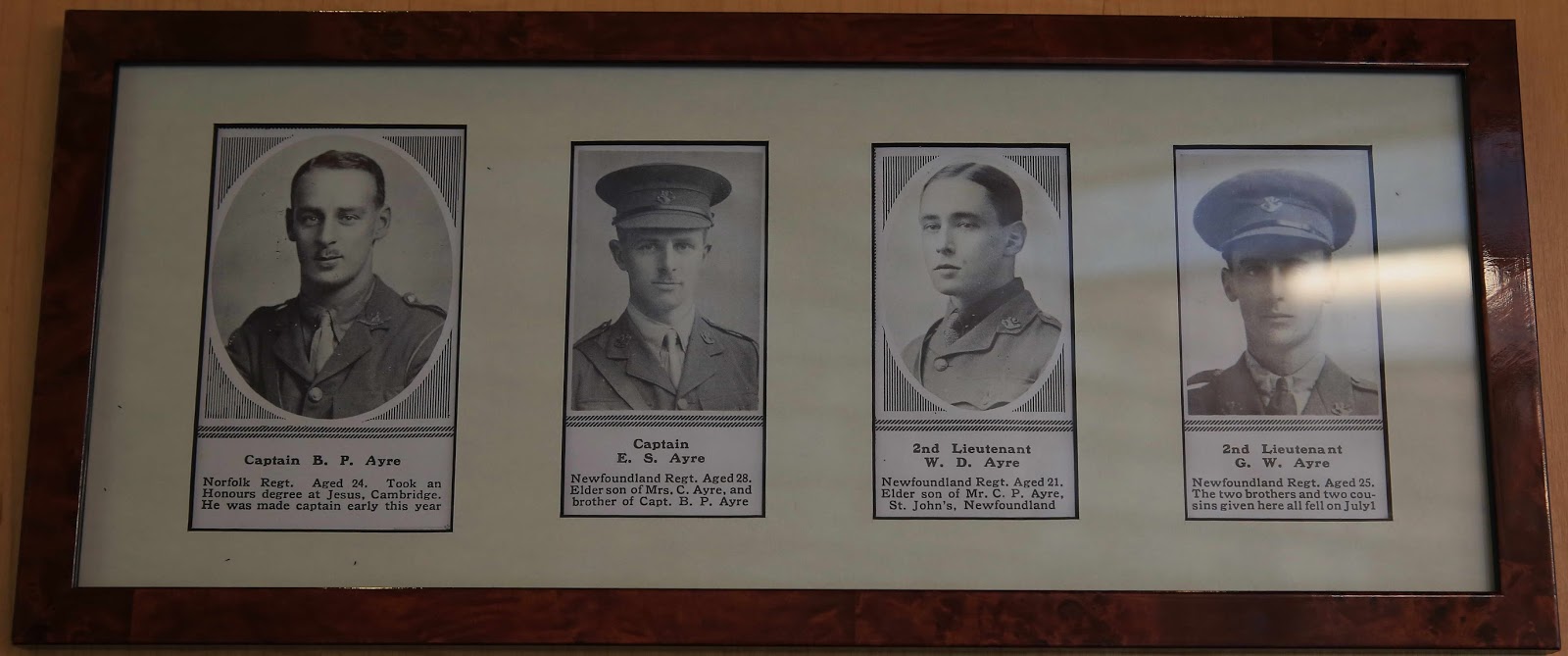
"we never heard him speak about the war"


These are on a wall behind a screen in a corner of the Newfoundland Regiment Information centre at Beaumont Hamel and this, below, is in the underground Somme 1916 Museum in Albert.

Scale.

Thursday 1st October 2015.

Faubourg - D'Amiens Memorial, Arras. Thomas Kilpatrick, miner from New Cumnock, Scotland, carved in limestone along with nearly 40,000 others with no known grave.

Lochnagar Crater. Blown at 0728, Saturday 1st July 1916. One big hole in the ground. You can walk around it but it's too steep to go down into let alone get out again.
24 tons of HE placed under the German trenches. The explosion was heard in London.

Thiepval British and French Memorial to The Missing of The Somme.
Nearly 80,000 names carved in limestone.


Beaumont Hamel. Google it.

Left as it was.
You can walk through the trenches, albeit grassed over and at least 2' shallower than they were.
You can look across a piece of ground no more than two football pitches in size and probably less.
That piece of ground was no man's land and the German lines are easily visible.

You can walk around to them in a few minutes.

They blew their mine at Hawthorn Ridge at 0720 on Saturday 1st July 1916 because the divisional commander, a British MP wanted to be first. This is the mine explosion that was filmed by a film unit and frequently shown in documentaries.

The troops were required to go over the top at 0730.

Those 10 minutes allowed the Germans to clean the soil from their weapons, bring up reserves and accurately site machine guns so that when the first attack began the Newfoundland Regiment was decimated.
The second attack took place at 0845 but failed because there were too many bodies from the first to allow any meaningful progress under machine gun fire.

Further attacks were mounted throughout the day.
By day's end the Newfoundland Regiment numbered 86 men and no officers.

As you stand in the front line trench it's hard to describe how small it all is but straight ahead  the Germans lay in "Y-Ravine" which curves around to your lower right and ends at what now a cemetery called "Y-Ravine Cemetery."
Along the crest to your left is another cemetery called "Hawthorn Ridge Cemetery."
It is where the mine was detonated and was the Newfoundlanders objective on Saturday 1st of July 1916.

Hawthorn Ridge was taken by The Highland Regiment in November 1916.

 A Caribou looks out above the Newfoundlanders trenches and from his position you look directly along the Ridge through a beautifully manicured avenue of trees at Hawthorn Ridge Cemetery.

It took us less than five minutes to stroll from Hawthorn Ridge Cemetery to The Caribou.

Yesterday I was struck quite forcibly by the fact that the front moved over a mere 12kms between July 1st and Mid-November but this, this is something else.

The area between the lines is roped off as the Canadians are unsure if it has been completely cleared of munitions or of the fallen. And, yes, I know that The Newfoundland Regiment was not Canadian. They were Newfoundlanders. I learned that yesterday, too.

Sheila's Grandad joined The Newfoundland Regiment on active service on The Somme on 12th July 1916.
His brother, Percy, had been wounded with them at Gallipoli.

Foreground stakes marks front line trench. Red board in centre of frame marks German front line. On the left you can see the memorial to the Highland Regiment. That monument lies behind the German lines. Extreme right is the edge of "Y-Ravine Cemetery."

Taken from outside "Hawthorn Ridge Cemetery." Just off to my left is the Highland Regiment Memorial in the photo above. This position is the site of the objective for The Newfoundland Regiment on 1st July 1916.. In the exact centre of the frame is the Caribou which lies behind the forward three trenches that they occupied.


Wednesday, September 30, 2015

15 minutes, 2 million dead.

At about 1400 today I left a motorway and found myself passing a sign that said 24th November 1916.
At about 1415 I passed a sign on that same arrow straight road from Bapaume to Albert which said 1st July 1916.

Less than 12km apart and yet over those five months in 1916 hundreds of thousands died. 88,000 Allied of which 56,000 British on July 1st 1916 alone. The French at Verdun is another story.

From August 1914 - November 1918, 750,00  British, 200,000 Commonwealth soldiers, 800,000 French ones. and over 350,00 civilains died along this front. No one seems to want to say how many Germans but over 800,000. 23,000,000 rounds of allied ammunition was expended on this front by the Allies.

I'm sitting here looking out of a window from a new Ibis just outside Albert with a laptop, baguette, cafe eclair, a dozen bottles of Leffe Blonde and the road runs just a few metres away. I can hear the cars. See the road. I'm watching the shadows stretching and the leaves detaching from their branches.
This road between the fence and the trees, arrow straight, smooth as silk and not exactly busy.

Yet this afternoon for the first time it has dawned on me the scale of the slaughter in WW1. If I were to cover all the ground on which British and Commonwealth troops were killed in WW2 I'd be travelling for ages covering continents, traipsing for miles but in WW1 it (nearly) all took place within a very narrow strip of land on this, The Western Front.

It has been a most sobering experience. Two million young men killed, not counting the enemy, in just a few months of a five year confrontation over a strip of land which took me less than 15 minutes to traverse at a legal speed

Two million deaths to take less than 12km of mud and barbed wire. Fighting petered out because of the weather and exhaustion but when it all began in the spring of 1917 those 12kms were lost again.

Driving here past the small neat cemeteries it all looks a bit too neat really, a bit romantic almost but an hour or two in the Somme 1916 museum in Albert destroys any latent romanticism. This was a deadly existence endured by many, survived by a few, forgotten by none.

In one action involving 3500 Canadians tasked with taking a wood one day in that July of 1916 the wood was taken and 143 were left to tell the tale. But they didn't tell the tale. They didn't talk about it. They didn't mention it. They just carried on. Sent to another unit. Another task. Another experience the horror of which I couldn't imagine.

No counselling, no understanding, no respite.

In that museum there's a Kilt and Sporran. Given by the granddaughter of a survivor of the horrors of July 1916. Her Grandad, wounded and unable to get back to his line and would have died but for a wounded Scot who carried him to safety and was further injured in doing so. The Scot, fatally wounded, gave her Grandad his Kilt and Sporran as "he had no one at home to send it to." They donated it to the museum with a photo of her Grandad. No one knows the name of the Scot.

The small neat cemeteries are dwarfed by the monuments on which the names of those with no graves are chiseled. But that's for tomorrow when we go to see the places where my wife's grandad fought his war.

A visit to the Somme 1916 museum in Albert is highly recommended, although ours was enriched by a group of British Primary schoolkids who were a credit to their parents and teachers but spoiled or at least overshadowed by a group of French teenagers accompanied by a thoroughly disinterested teacher whose behaviour was atrocious to say the least.

I'm glad I read "Catastrophe" by Sir Max Hastings and I'd recommend that, too.

A salutary day.